Of Corpses & Conundrums
The murder victim's spirit hadn't moved.
Violet—Bernie, she had to think Bernie now, always Bernie—knelt beside the body and opened the equipment case with movements made automatic by grief and years of practice. The spirit stood exactly where she'd first appeared, three feet from the wall where her corpse had been arranged like a macabre tableau. Translucent. Watercolor-faint. Staring down at the stumps of her wrists with an expression of such profound confusion that Violet's chest ached.
Not yet. First the photographs. Work first, always work first, just as Poppa had taught her.
"I'll need space to set up the tripod," Bernie said, voice dropped to that careful octave lower. The binding corset made her ribs complain with every breath. "And someone to hold the flash powder. It's too dark down here for a clean exposure otherwise."
Detective Flanahan stepped back immediately, his movements economical and purposeful. "Jenkins." He gestured to one of the constables. "Help Mr. Abrams with whatever he needs."
The constable—young, with nervous hands that suggested this was one of his first murder scenes—hurried forward. Bernie handed him the flash powder apparatus and watched him nearly fumble it.
"Hold it here," Bernie said, positioning him with firm hands. "When I say, you'll trigger the powder. Don't look directly at the flash unless you fancy seeing spots for the next hour."
"Y-yes, sir."
The tripod went up quickly. The camera mounted, the black cloth draped. Violet had done this hundreds of times, perhaps. The familiar routine steadied her, even as her hands wanted to shake. Even as the spirit's presence pulled at the corner of her vision like a persistent ache.
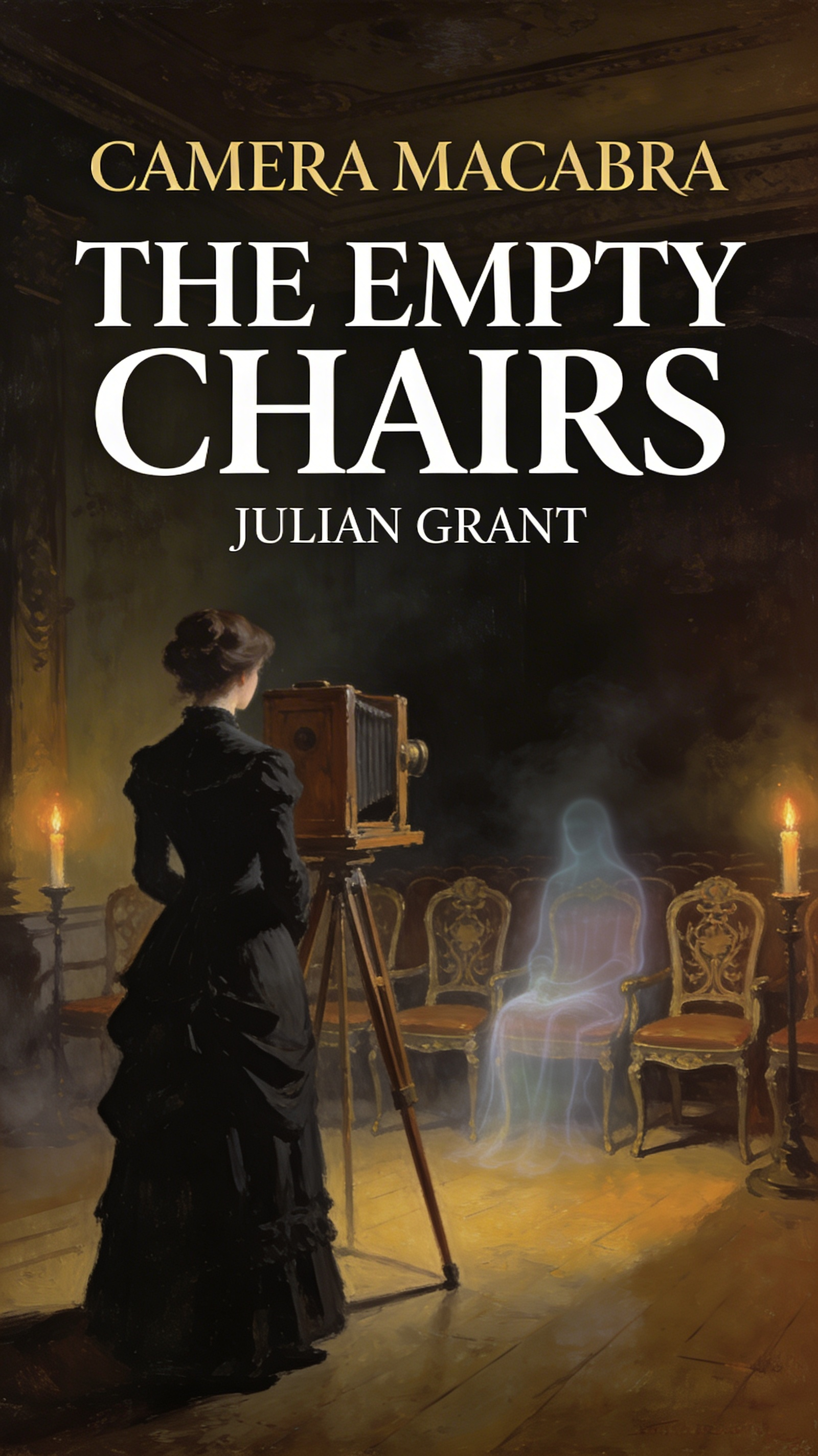
She pulled the dark slide from the first plate holder, exposing the wet collodion plate beneath. Through the ground glass, the scene inverted: the victim's body pale against dark brick, the wrapped stumps of her wrists like white flowers blooming from the sleeves of her dress.
"Hold still," Bernie called. To the living. To the dead. To herself.
Count of thirty. The flash powder ignited with its characteristic crack and bloom of acrid smoke. The constable yelped but held position. Good lad.
Violet slid the dark slide back into place, marked the plate holder with a quick chalk notation—Dead Man's Hole, October 1895, full scene—and reached for the next.
She worked methodically. Wide shots establishing the scene. Medium shots showing the body's position against the wall. Close shots of the wrapped wrists, the careful precision of the binding, the way the cloth had been tied with what looked almost like care. Close shots of the victim's face—peaceful, unmarked, as though she'd simply fallen asleep leaning against cold brick.
The whole time, the spirit watched.
Not Violet. Not the constables or Flanahan. The spirit watched her own body with that terrible confusion, occasionally lifting her translucent hands—whole, complete, phantom fingers flexing—and comparing them to the stumps wrapped in white cloth.
Not yet, Violet told herself again. Finish the work.
But her hands were shaking now, and the next plate nearly slipped from her grip. She caught it, forced her breathing steady, and loaded it into the camera with the kind of deliberate care that came from operating on the knife's edge of composure.
"You alright, Mr. Abrams?" Flanahan's voice came from behind her shoulder—quiet, concerned. His Irish lilt softened the question into something almost gentle, and when Violet glanced back, his blue eyes were steady on her face. Not intrusive. Just... attentive. Like he actually cared whether this strange young photographer was managing or not.
"Fine." Bernie's voice came out rougher than intended. "Just cold."
It wasn't cold. October in London, yes, but the alley trapped the day's meager warmth between its crooked walls. Violet was shaking because the spirit had started to move, drifting closer to her own corpse, and because she could feel the weight of unfinished business radiating from the translucent figure like heat from a stove.
Flanahan didn't push. Just nodded once and stepped back, giving her space. That was... unusual. Most men in his position would have pressed, or dismissed her claim entirely, or made some joke about delicate constitutions. Instead, he simply believed her and left her to it.
Violet filed that observation away and took the next shot.
One more plate. One more shot. The victim's hands, the missing hands, the wrapped stumps, the careful white cloth—
Violet triggered the flash powder herself this time, and in the brief brilliant flare, she saw the spirit flinch.
Now.
"I need to develop these," Bernie said, straightening and pulling the black cloth from the camera. "Before the collodion dries. Is there somewhere nearby with running water? A pump, preferably?"
Flanahan frowned, considering. "There's a courtyard two streets over. Communal pump. Used to be a stable yard before the buildings went up around it."
"That'll do. I'll need twenty minutes. Half hour at most."
"I'll send Jenkins with you—"
"No need." Bernie was already packing the plate holders into their protective case, movements brisk and businesslike. "I work better alone. Developing's particular work. Easy to ruin if someone's breathing over your shoulder."
It was true enough, and Flanahan seemed to recognize that. He nodded, though his expression suggested he didn't entirely like the idea of letting a witness—even a photographer—wander off alone from a crime scene. "Right then. Jenkins will show you to the pump, then leave you to it. But stay in the courtyard, aye? I'll need you back here to verify the photographs once they're done."
"Of course, Detective."
Bernie hoisted the equipment case—heavy, but she'd been hauling photography equipment since she was twelve years old, and her arms knew the weight—and followed the young constable out of Dead Man's Hole. The spirit drifted after them, silent as fog, her translucent form passing through the brick wall rather than navigating around it.
The courtyard was exactly what Bernie had hoped for: a cramped square of cracked paving stones, a rusted iron pump in the center, and—most importantly—no one around. Jenkins showed her the pump, demonstrated that it worked with a few experimental pumps that brought up clear water, and then retreated at Bernie's curt nod, his footsteps echoing away down the narrow street.
The moment he was gone, Violet let herself sag against the pump handle.
"You can see me." The spirit's voice was soft. Wondering. Not yet frightened, which was something. "You looked right at me. In the alley. You can see me."
Violet straightened, forced Bernie's gruff voice back into place even though there was no one to hear. "I can see you. I can hear you. And I need you to tell me what happened."
The spirit drifted closer. She was younger than Violet had first thought—mid-twenties, perhaps, with dark hair that had been carefully pinned and a face that would have been pretty if it weren't slack with confusion. Her dress was good quality, deep blue wool with jet buttons, the kind a shopgirl might save six months to afford. Not wealthy, but not poor either.
"I don't..." The spirit looked down at her hands again. Whole. Phantom. "I don't understand. Where are my hands? Why can't I feel them?"
"You're dead," Violet said. Gentle but direct, because there was no kind way to say it. "Someone killed you. Took your hands. I'm trying to find out who."
"Dead." The spirit tested the word, her translucent face rippling with emotion like water disturbed by a stone. "I'm dead. I'm... oh. Oh, I remember now. There was a man. A theater. He said he wanted to show me something beautiful."
Violet's heart kicked hard against her ribs. "What man? What theater?"
But the spirit was fading already, her translucent form flickering like a candle in a draft. Confusion did that sometimes—the shock of understanding scattered whatever held them together, and they came apart like smoke.
"Wait—" Violet reached out uselessly, her hand passing through empty air. "What theater? What did he look like?"
"Beautiful," the spirit whispered, her voice distant now, thin as spider silk. "He said he'd make me beautiful forever. He said—"
Gone.
Violet stood alone in the courtyard, her hand still extended toward nothing, her chest tight with frustration and something darker. Fear, maybe. Or recognition.
He said he'd make me beautiful forever.
She looked down at the equipment case, at the plate holders inside that contained images of a woman posed like art against a brick wall, her missing hands wrapped in clean white cloth as carefully as a gift.
Beautiful. Careful. Precise.
This wasn't rage or frenzy. This was something worse.
This was intention.
Violet pumped water into the developing tray with shaking hands and got to work.
The photographs came out clean.
Too clean, really. Violet stared at them in the courtyard's fading light, the wet prints held carefully by their edges, and felt her stomach turn over with a sickness that had nothing to do with the chemicals.
The victim looked peaceful in every shot. Arranged. The white cloth wrapping her stumps had been tied with actual ribbon—she could see it now in the close-up shots, thin silk ribbon in a careful bow, the kind you'd use to wrap a present. The body positioned against the wall at an angle that was almost graceful. The dress smoothed, the hair tidied, the face composed.
Whoever did this had taken their time.
Had cared about the presentation.
Violet's hands wanted to shake again. She forced them still and slid the photographs into their protective envelope, then packed up the developing equipment with the kind of methodical care that kept her from thinking too hard about what she'd just captured.
When she returned to Dead Man's Hole, Detective Flanahan was exactly where she'd left him, standing three feet from the body with his arms crossed and his scarred face set in an expression of grim determination. He was questioning one of the other constables in a low voice, his questions precise and methodical—who found the body, at what time, had anyone else been in the alley that morning?
He looked up when Bernie approached, and something in his expression shifted. Relief, maybe. Or just professional interest in the photographs.
"Got them," Bernie said, offering the envelope. "Six plates. Full scene, medium shots, and details of the binding."
Flanahan took the envelope with careful fingers—Violet noticed he handled the photographs the same way she did, by the edges, as though they were something precious that shouldn't be marked—and studied them in silence. His jaw tightened as he went through them one by one. After a long moment, he looked up, and there was something fierce in his blue eyes that made Violet take an involuntary step back.
"These are good," he said quietly. "Better than good. You can see... Christ, you can see the ribbon."
"Aye." Bernie nodded. "Silk, I think. Expensive."
"The bastard wrapped her hands like a gift." Flanahan's accent thickened with anger, his r's rolling harder. "Three weeks. Three women. And he's getting bolder."
Violet—Bernie—made herself ask the question, even though she thought she already knew the answer. "The other victims. Were they... arranged like this? Posed?"
"Aye." Flanahan's gaze flicked back to the photographs, and Violet could see him cataloging details the way she cataloged light and shadow. "First one was in Spitalfields. Missing her eyes, sockets packed with cotton wool and sewn shut with careful stitches. Positioned sitting against a wall like she was resting." He paused, his voice dropping. "Second one was off Commercial Road. Missing her tongue, mouth bound shut with silk thread, laid out on a doorstep like a sleeping child."
Another pause. When he continued, his voice was clinical, professional, but Violet could hear the anger underneath. "Coroner says the removals were done after death in all three cases. Clean cuts. Medical training, he thinks. Someone who knows anatomy."
Beautiful. He said he'd make me beautiful forever.
Violet swallowed hard. "Any connection between the victims?"
"Not that we've found. Different ages, different backgrounds. First was a laundress, forty-odd years old. Second was a flower seller, nineteen. This one—" He gestured to the body. "Haven't identified her yet, but her dress suggests she works somewhere respectable. Shopgirl, maybe, or seamstress."
"Different women," Bernie said slowly. "But all... arranged. Like he's making something."
"Aye." Flanahan's voice was grim. "Question is what."
Violet didn't answer. She was thinking about theaters and beauty and careful presentation. About someone who knew anatomy, who had medical training, who took surgical precision and turned it into something that looked almost like art.
She was thinking about the ribbon tied in a bow.
"I'll need these photographs," Flanahan said. "For the investigation. Can you make copies?"
"Aye. It'll cost extra."
"Scotland Yard will pay." He paused, then handed back three of the photographs, keeping three for himself. "Keep these for your records. And Mr. Abrams?"
He met Violet's eyes directly, and the intensity there was uncomfortable but not unkind. Just... serious. Earnest, in a way that suggested he meant what he was about to say.
"Thank you. For not flinching. For doing this properly. Most photographers I've worked with treat it like a job. You treat it like it matters."
"It does matter," Bernie said. The words came out before Violet could think to stop them, more emotion bleeding through than Bernie would typically show. "She matters. They all matter."
Something shifted in Flanahan's expression—respect, maybe, or recognition. His eyes held hers for a moment longer, and Violet had the uncomfortable sensation of being seen. Not Bernie. Her. The person underneath.
Then he nodded once, breaking the moment. "Aye. They do."
He turned back to the scene, already calling for Jenkins to help with the body transport, and Violet took that as her dismissal. She gathered up her equipment, nodded to Flanahan's back, and made her way out of Dead Man's Hole.
But as she walked, she could still feel the weight of his gaze. The way he'd looked at her when she said they mattered. Like he understood something important about who she was, even if he didn't know exactly what.
It was dangerous, that kind of seeing.
And terrifying.
And—if Violet was being honest with herself—a little bit thrilling.
By the time Violet made it back to Carter Square, full dark had fallen and the binding corset felt like it was crushing her ribs into powder. The studio was dark when she unlocked the door, but she could see lamplight under the door that led to the back storage room where Artie slept.
"Artie?" Bernie's gruff voice echoed in the empty front room. "Still awake?"
Footsteps, quick and light. Artie emerged from the storage room in his nightshirt, lamp in hand, his dark face creased with worry. "You're back. Thank God. I was starting to think—" He stopped, took in Bernie's expression, the equipment case heavy in her hands. "Bad, then?"
"Bad." Violet—still Bernie, always Bernie when Artie could see—set down the case and leaned against the worktable. Her whole body ached. "Murder. Third one in three weeks. Police want me to photograph the scenes."
Artie's eyes went wide. "Murder scenes? Violet, that's—" He caught himself. "I mean, that's good money, yeah? Police pay well."
"Ten shillings a scene. More if I testify." Bernie pulled off the false beard with a wince, the spirit gum tugging at her skin. "And yes, before you ask, I'm going to keep doing it. We need the money, and..." She paused, choosing her words carefully. "I might be able to help. Really help. More than just making pictures."
Understanding dawned in Artie's expression. "The gift."
"The gift."
Artie set down the lamp and helped Violet ease out of the heavy wool coat. "Did you see her? The victim?"
"Her spirit. Yes." Violet fumbled with the binding corset, fingers numb from cold and exhaustion. "She didn't know much. Confused. But she said something about a theater. About a man who wanted to make her beautiful."
The corset loosened. Violet took her first full breath in hours and felt her ribs expand with blessed relief. Behind the changing screen, she stripped off Bernie's layers and pulled on the simple blouse and dark skirt that belonged to Violet, to herself, to whoever she was when no one was watching.
When she emerged, Artie was still waiting, his expression troubled.
"A theater," he said slowly. "Which theater?"
"She didn't say. Faded before I could ask more." Violet crossed to the worktable and sank into the chair there, suddenly exhausted down to her bones. "But three victims, Artie. Three women, all arranged like... like art. Someone's making something out of them."
"Christ." Artie rubbed his face. "And the police don't know about your gift."
"No. And they can't. Not ever." Violet looked up at him, held his gaze. "You understand that, right? If they knew, if anyone knew—"
"I know." Artie's voice was firm. "You'd end up in Bedlam or worse. Burned as a witch or locked up as mad. I know, Violet. I won't tell. I'd never tell."
She believed him. Artie had been keeping the Bernie secret for two years now. Had never once slipped, never once questioned. He was loyal down to his bones, and Violet trusted him more than she trusted almost anyone.
Almost.
"Get some sleep," she told Artie. "Tomorrow, we start properly. Bernie Abrams, photographer. Legitimate businessman. And..." She paused, thinking about wrapped stumps and silk ribbon and a spirit's confused whisper about beauty. "And we find out which theaters are in Whitechapel. Someone's making art out of murder. Maybe if we find the theater, we find him."
Artie nodded slowly. "Right then. Theaters. I can ask around. People talk to me—street kid, you know. Invisible."
"Good." Violet managed something that wasn't quite a smile.
"Get some sleep," she told Artie. "Tomorrow, we start properly. Bernie Abrams, photographer. Legitimate businessman. And..."
She paused, thinking about wrapped stumps and silk ribbon and a spirit's confused whisper about beauty. "And we find out which theaters are in Whitechapel. Someone's making art out of murder. Maybe if we find the theater, we find him."
After Artie left, Violet sat alone in Poppa's study with the box open before her and the letter in her hands. Twenty pounds. Six months. Bernie's papers and Poppa's blessing and a serial killer who wrapped his victims' wounds with ribbon.
Somewhere in Whitechapel, three women's spirits lingered, confused and searching. One had spoken to Violet. The others might too, if she could find where they'd died.
He said he'd make me beautiful forever.
Violet closed the box, extinguished the lamp, and went to bed.
Tomorrow, Bernie Abrams would open for business.
Tonight, Violet Abrams allowed herself to grieve.