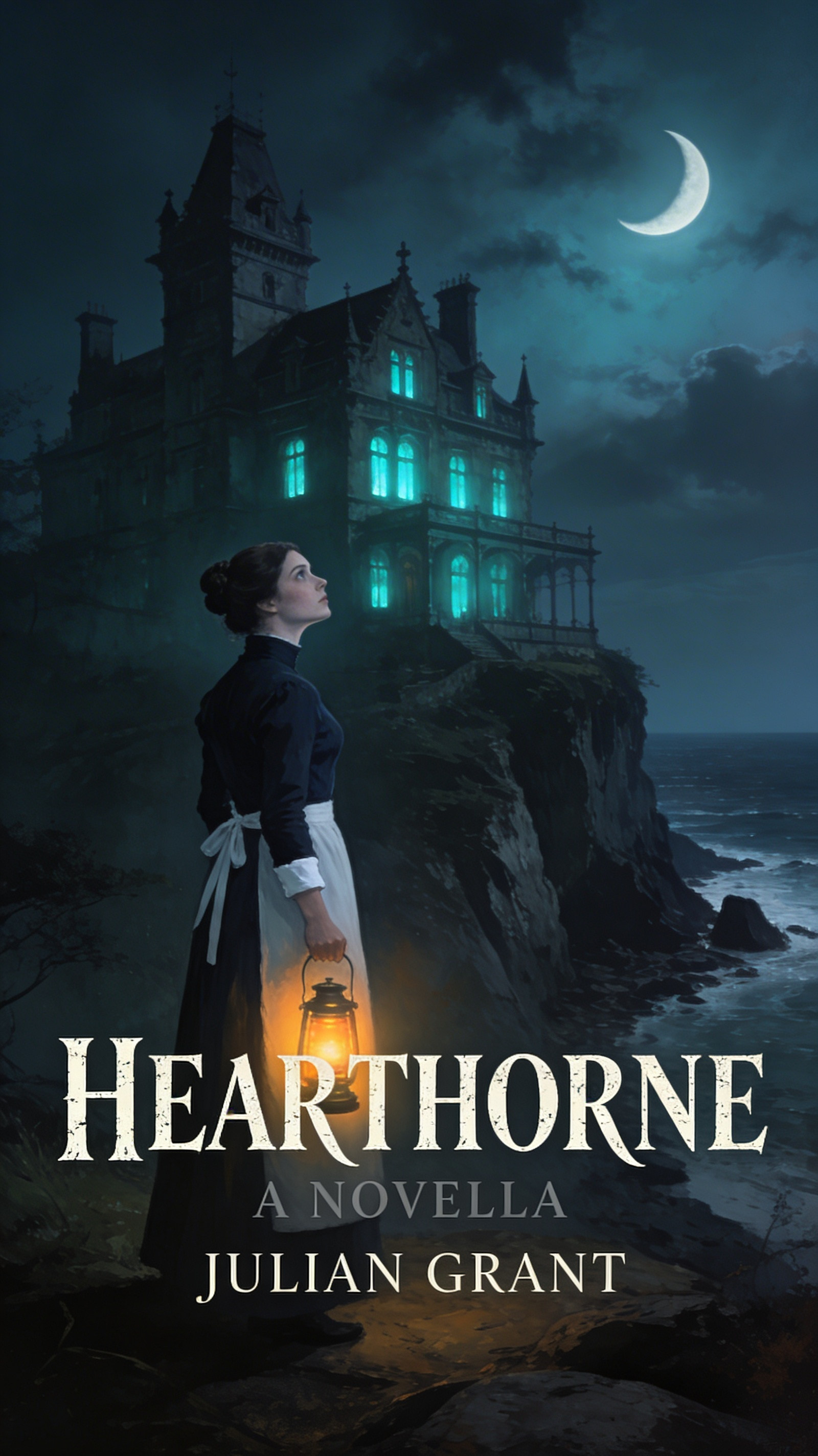
[Document recovered from Professor Soames's effects after his complete incapacitation, December 1870. Never sent. Written over several days in late October, representing his final sustained period of lucidity.]
To the Chief Constable of Lincolnshire, or to Whomever May Discover These Papers:
I am Professor Avery Soames, formerly of Edinburgh Medical College, specialist in mesmerism and disorders of consciousness, currently resident physician at Hearthorne Manor. I write this testament in full knowledge that it will likely never be read, or if read, disbelieved. Nevertheless, conscience and professional duty compel me to document what I have witnessed at this estate over the past fifteen years. If nothing else, let this serve as warning to future investigators who may find themselves drawn—as I was—to explain the inexplicable.
I came to Hearthorne in October of 1855. Lady Olivia, newly widowed, sought a physician with expertise in nervous disorders. Her previous nurses had developed peculiar symptoms before their sudden departures, and she wished for someone with specialized knowledge to attend the manor. The position included generous compensation and lodgings within a private wing of the house. My practice in Edinburgh had proven satisfactory but not remunerative; I accepted with alacrity.
I married Lady Olivia in the spring of 1856. She was, I believed, a respectable young widow of considerable means seeking companionship and professional care in equal measure. The marriage was one of practical convenience. She required a physician in permanent residence after losing her husband and all family to the inhospitable channel waters the season before. I required stability and resources for my research. We reached what I thought was a rational understanding between two adults of sense.
I was incorrect. I understood nothing.
I. THE PATTERN REVEALED
My first indication that something was profoundly wrong came in December of 1856, when Miss Catherine Morley—the young nurse Lady Soames had retained to assist with household medical matters—disappeared without warning on the night of December 21st. Miss Morley had been in good health and cheerful spirits. She left no note, took no belongings, and was last seen walking toward the fenlands at approximately eleven o'clock in the evening. Her body was never recovered.
Lady Soames seemed curiously untroubled by this disappearance. "The fens claim many," she said, and would discuss it no further.
I might have accepted this as tragic but explicable. The marshlands surrounding Hearthorne are treacherous, particularly in winter. But then Miss Elizabeth Hartwell disappeared in identical fashion in December of 1857. Same date. Same hour. Same destination. And Miss Sarah Pemberton the following year. And Miss Margaret Agincourt after that.
By 1860, I could no longer attribute these disappearances to coincidence. I began to investigate in earnest.
I discovered that the pattern extended far beyond my tenure at Hearthorne. Through careful examination of parish records, I documented similar disappearances occurring annually on December 21st dating back to at least 1841. Young women between the ages of twenty and thirty, most employed as nurses or companions at the manor, all vanishing without trace on the winter solstice. I found memorial stones in the fenlands bearing strange symbols and dates—stones that, I later learned, Lady Soames herself had commissioned and had placed.
The pattern was not random.
It was ritual.
II. THE ENTITY
What follows will strain credulity beyond breaking. I would not believe it myself had I not observed it directly, documented it in sixty-three volumes of detailed journals, and corresponded with Dr. Giuseppe Mariani of Venice who has independently observed similar phenomena in the Adriatic lagoons.
There exists, I believe, beneath Hearthorne Manor—beneath the fens, beneath the limestone bedrock itself—something that defies conventional understanding of biology, physiology, or natural philosophy. I hesitate to call it a creature, for that implies animal nature. Nor is it spirit or demon, for those are constructs of theology rather than science. It simply is, vast, ancient, existing in dimensions that intersect with but do not entirely occupy our own.
The locals refer to it obliquely, when they speak of it at all, as "the Old One" or "what dwells beneath." They have known of its presence for generations, perhaps centuries. Their ancestors made accommodations with it long before recorded history. The annual tribute of young women represents the continuation of an agreement struck when this land was first settled.
The entity dwells in subterranean waterways that connect the fen-channels to deeper limestone caves, which in turn connect to still deeper ocean trenches. I have examined maps and geological surveys. The limestone beneath Lincolnshire is honeycombed with passages formed over millennia by water erosion. Some of these passages descend to depths where pressure alone should render any form of life impossible. Yet the entity that exists at these depths—indeed, appears to prefer them.
It is, in the most literal sense, a creature of the deep.
Why does it require human mates? Dr. Mariani theorizes—and my own observations support this—that the entity engages in a form of hybridization. It breeds with the women brought to it, producing offspring that possess characteristics of both parent species. These young are neither fully human nor fully what the entity is, but exist in a liminal state between terrestrial and abyssal life. They can survive in extreme depths and pressures. They can navigate both underwater and terrestrial environments. They represent, in evolutionary terms, a bridge between two incompatible forms of existence.
I have seen drawings of these offspring. They are beautiful in ways that disturb rather than please—elongated limbs, skin that shifts between human and something more aquatic, eyes adapted for darkness, breathing structures that can process both air and water. One might call them monsters. One might also call them the next stage of human adaptation to a planet largely covered in ocean.
The entity is not evil in any moral sense. It simply continues a biological imperative as old as life itself: to reproduce, to persist, to spread its species throughout the world's waters. That human women are necessary for this process is a quirk of compatible biology, nothing more.
This lack of malice makes it no less horrifying.
III. THE MARKING
The entity does not choose its brides at random. Each woman who disappears from Hearthorne was marked years earlier, during childhood, through near drowning.
The marking occurs spontaneously when a child finds herself submerged in water—ocean, lake, river, even a deep basin. For reasons I do not fully understand, the water itself appears to possess a kind of awareness, or perhaps the entity's presence permeates all connected bodies of water. When a child goes under, this awareness tastes her, assessing her biological suitability for eventual transformation and breeding.
Most children are found unsuitable. They surface, sputter, and continue their lives unmarked. But for a rare few—perhaps one in several thousand—the water finds compatibility. It marks them. Physical evidence of this marking appears along the ribcage and neck: gill-like structures that remain dormant, nearly invisible, until proximity to a ritual site activates them years later.
The marked child retains no conscious memory of the drowning. The trauma is suppressed, or perhaps the marking itself erases recollection. She grows to adulthood with no awareness of what swims in her blood, what waits dormant in her flesh. Lady Soames possesses an uncanny ability to identify these marked women. She employs them as nurses, brings them to Hearthorne during their early twenties, and ensures they remain at the manor through the autumn preceding their transformation.
I have determined through patient observation that certain bloodlines appear more susceptible to successful marking. Lady Soames herself comes from such a line. Her mother before her served the entity, as did her grandmother and great-grandmother stretching back generations. The Soames women are priestesses by inheritance, maintaining the estate and ensuring the annual tribute continues.
IV. THE TRANSFORMATION
Once a marked woman arrives at Hearthorne, the transformation begins immediately, though the victim perceives it only gradually. The process unfolds over approximately eight weeks, culminating on the winter solstice when the victim walks willingly into the water to complete her change.
I have documented the progression with medical precision across sixteen cases:
Week One: The dormant marks activate. Temperature begins to drop from the normal 98.6°F toward 95°F. The victim reports increased thirst and preference for cold water. Dreams intensify, featuring underwater imagery. Pulse rate decreases as circulatory system begins reorganization.
Week Two: Temperature continues declining toward 93°F. Gill marks become visible as raised structures along ribs and neck. Internal cartilage begins forming within these structures. Skin texture changes, becoming slightly translucent, showing subcutaneous vessels. The victim can hold breath for extended periods. Salt cravings emerge.
Week Three: Temperature approaches 91°F. The victim begins experiencing brief periods of breathing through the gill structures, usually during sleep. This causes initial alarm but is quickly accepted as "normal." Diet shifts entirely to liquids, solid food causes nausea. Skin develops a faintly mottled quality. Dreams become more vivid than waking life.
Week Four: Temperature reaches 90°F or below. The victim can now breathe water successfully. If immersed in a basin, the gill structures operate independently, extracting oxygen from water as efficiently as lungs extract it from air. The victim begins showing signs of psychological fragmentation—referring to herself as "we" or "many selves." Memory of pre-transformation life becomes dreamlike, uncertain.
Week Five: Temperature stabilizes around 88-89°F. The body is now adapted to function in near-freezing water. Internal organs have undergone significant restructuring to withstand pressure. The victim prefers to remain in cool, damp environments. She loses interest in human food, human conversation, human concerns. English becomes difficult; she speaks increasingly in a language I cannot identify—something aquatic, composed of sounds that should be impossible for human vocal cords to produce.
Week Six: Physical transformation nears completion. The skin is fully mottled, cold to the touch, constantly damp. Eyes begin showing structural changes, slight vertical elongation of pupils, improved night vision. Hair and nails show subtle alterations. The victim spends most of her time in water when possible—bathing, swimming, simply standing in the rain. She speaks almost entirely in the underwater language now.
Week Seven: Identity has essentially dissolved. The victim no longer responds to her own name. She does not recognize her own reflection as "self." All memory of previous life has faded into shadows. She exists in a state of eager anticipation, waiting for December 21st. Strange writing appears on her arms and hands—markings that shift and reconfigure, written in the victim's own veins. Lady Soames calls this "the Call." It is both instruction and summons.
Week Eight: The final week. The victim is no longer recognizably human in thought or desire, though her physical form remains predominantly human in appearance. She waits with increasing agitation for the appointed night. She practices descending in bathtubs, testing how long she can remain submerged. She speaks with what awaits her in dreams. She *wants* to go. By December 21st, no force could prevent her from walking into the water. She would fight, she would claw, she would die trying to reach it.
But no one tries to stop her. By the solstice, everyone who witnesses her transformation understands that she is already gone.
V. THE RITUAL
December 21st. The winter solstice. Midnight.
I have observed this ritual eight times from a safe distance, using field glasses from the manor's upper windows. I would have observed more, but my own transformation began eight years ago, limiting my mobility and lucidity.
The victim walks to the old boat landing at the manor's eastern boundary where the fen-channels connect most directly to deeper subterranean waterways. She wears only a thin shift or nothing at all—clothing is irrelevant to her now. The cold that would kill an ordinary person in minutes causes her no distress. Indeed, she appears to find it pleasurable.
Lady Soames always accompanies her to the water's edge. She speaks words I cannot hear, perhaps prayers, perhaps instructions, perhaps simply acknowledgment that the years’ service is complete. Then she watches as the victim enters the water.
The victim does not hesitate. She walks forward until the water reaches her chest, then her neck, then closes over her head. She submerges and continues walking deeper into the fen-channels that most locals know to avoid. Within moments she is swimming—diving—descending with purpose and direction.
I hired men to watch the fens for several hours after each ritual, to see if the victims emerged. They reported seeing lights in the deeper water—phosphorescent glows moving at depths the fen-channels should not possess. Sometimes they saw shapes: long, pale limbs, hair streaming like seaweed. Once, they clearly saw a woman's face beneath the surface, but she was swimming at a depth and speed impossible for any unaltered human.
The victims do not die. They transform.
They descend through the fen-channels to the limestone caves, then deeper still to subterranean rivers that connect to ocean trenches. There, at depths where pressure would crush an ordinary human skull like an eggshell, they reach the entity itself.
I will not describe what I believe occurs in that final meeting. Dr. Mariani's correspondence suggests it involves biological union—breeding in the most literal sense. The victims become mothers to something neither human nor aquatic creature, but a new form of life adapted to environments we cannot survive.
Some of these women, after years in the depths, return to the shallows near Hearthorne. The watchers have seen them. They retain human shape but move with alien grace. They can breathe air if needed but prefer water. They watch the manor with what might be curiosity or might be something else entirely. Lady Soames herself was one such bride thirty years ago. She returned to the surface, lives at the manor, serves as head priestess, and ensures the pattern continues.
She has given birth three times. The offspring left immediately swimming to depths even she cannot reach.
VI. LADY SOAMES
I loved her, in the beginning. I thought I understood what our marriage was—a practical arrangement between rational adults. I did not realize I had married something only partly human.
Lady Soames was marked as a child near Scarborough. She walked into the Hearthorne fens on December 21st, 1842, at the age of nineteen. Her mother called her from the shore—her mother, who had undergone the same transformation years earlier. The Soames women are born to this. It is their inheritance and their duty.
She spends most of her time on land, maintaining the appearance of normalcy, managing the estate, identifying and recruiting new nurses. But she can slip into water at will and remain there for days if she chooses. She prefers the cold and the dark. She tells me she feels the entity calling her even now, thirty years after her transformation. The water remembers what we were before we learned to walk on land, she says. This is not horror, this is homecoming.
She performs the conditioning. Every victim who walks willingly into the water on December 21st does so because Lady Soames has visited her nightly, whispering into her sleeping mind, touching her marked flesh, making desire bloom where resistance should reside. She knows exactly which words to use, which images to plant, how much pressure to apply. She has conditioned twenty-nine women over twenty-nine years. Not one has resisted at the end.
She prefers strong-willed victims. The entity, she says, prefers minds that struggle until final surrender. There is something in the anguish of conscious capitulation that sweetens the transformation. I have come to understand this is not cruelty—at least, not as she experiences it. She views this as a gift. She believes she is liberating these women from the prison of terrestrial existence, allowing them to return to humanity's true element: the deep water where life first emerged.
When I confronted her eight years ago—when I finally understood what she was doing and threatened to expose the pattern to authorities—she took me to the water. She did not kill me. Death would have been merciful.
Instead, she marked me. Not for breeding, but for service.
The water entered my lungs, my blood, my nervous system. It wrote itself into my brain tissue, my capacity for speech, my ability to act independently.
Now I can think but not act meaningfully. I can understand but cannot intervene. I can warn but only in fragments, only too late. She has made me into a demonstration, a warning to those who would resist, and a tool to deepen others' horror and thus hasten their surrender.
Knowledge is not power when the thing you know is inevitable.
VII. MY ATTEMPTS AND MY FAILURES
Over fifteen years, I have documented sixteen complete transformations. I attempted to save every single victim. I failed every single time.
I tried isolation—removing the victim from Lady Soames' influence. The transformation continued. The marks had already activated; proximity to the manor was not required for progression, only for monitoring.
I tried medicine, every treatment available to 19th-century medical science. Purgatives, sedatives, tonics, dietary restriction. Nothing altered the temperature decline, the gill development, the psychological erosion.
I tried appealing to reason—showing victims my journals, explaining the pattern, detailing what awaited them. They read the information with apparent interest, agreed it was horrifying, then continued transforming anyway. By week six, they no longer remembered reading my warnings.
I tried exorcism, bringing a priest who specialized in such matters. He performed elaborate rituals over Miss Eleanor Grayson in 1863. She attended the ceremonies docilely, then walked into the water precisely on schedule.
I tried physical restraint—locking Miss Victoria Lambert in her room during the final week in 1865. She broke the window with her bare hands, suffering lacerations that healed with unnatural speed, and made her way to the water. She was laughing as she entered.
I corresponded with every medical colleague who might offer insight. Most dismissed my accounts as fantasy or madness. Dr. Mariani in Venice was the only one who took me seriously, as he had observed similar phenomena. But his attempts to intervene in Italian cases met with identical failure. The pattern exists in multiple locations worldwide, he believes. Wherever deep water connects to limestone caves, wherever ancient things dwell in the crushing dark, similar arrangements persist.
Every woman I tried to save told me, near the end, that she was choosing this. She wanted it. She was grateful. The conditioning was so thorough, so complete, that they could not distinguish their own desires from what Lady Soames had implanted in their sleeping minds. They experienced surrender as liberation. They experienced violation as consummation.
By December 21st, they begged to go.
I have failed sixteen times. I will fail again with Miss Beatrix Chalmers. The pattern is unbreakable. It has persisted for at least two hundred years. It will persist for two hundred more.
VIII. MY TRANSFORMATION
I write this during one of my final lucid periods. Soon—perhaps in days, perhaps in hours—what remains of my coherent thought will dissolve entirely into the underwater language that increasingly dominates my mind.
Eight years ago, Lady Soames took me to the deep channels. She held my head beneath the surface until my lungs filled. I expected death. Instead, I felt the water tasting me, reading me the way it reads marked children. But I was not found suitable for breeding. I was marked for something else: observation, documentation, warning.
The water entered every system of my body. It rewrote the neural pathways in my brain. Now I can think in two languages simultaneously: human and underwater. I can understand both worlds, but act meaningfully in neither. I am trapped between serving as a bridge and a demonstration.
I feel what the victims feel as they transform. I hear what calls from the deep. I know what Lady Soames knows—the pleasure of deep swimming, the freedom of breathing water, the exquisite pressure of descending to crushing depths that feel like embrace. I understand why she does this willingly, year after year. The entity is not violation. The entity is completion. Return to primordial waters. Liberation from the painful, brief, limited existence of terrestrial life.
But I was not transformed fully. I retain enough humanity to find this horrifying. And not enough to stop it.
On bad days, I can barely speak English at all. The underwater language bursts from my throat in wet sounds that hurt to produce. Writing becomes impossible—my hands form symbols in languages I do not consciously know. On good days, like today, I can write coherently for a few hours before the water language reclaims my mind.
This is my punishment for resistance. Lady Soames keeps me alive because my suffering serves her purpose. New nurses see me—see what I have become—and their questions begin their own investigations. But the investigation only deepens horror. Horror only hastens surrender. I am warning that warns too late, knowledge that provides no power.
Soon I will lose the ability to write in English entirely. Soon all that will remain is the underwater self, the one that knows what swims beneath Hearthorne and finds it beautiful. I will still observe, still document in my sixty-three journals hidden behind the false panel in the library's east wall. But the documentation will be in symbols that shift and reconfigure, in languages of depth and pressure and cold.
This letter represents my final attempt to warn in words that others might understand.
IX THE CURRENT VICTIM
Her name is Miss Beatrix Chalmers. She is twenty-four years old. She arrived from London in October, seeking employment as a nurse. She is intelligent, educated, strong-willed, and utterly doomed.
Lady Soames identified her immediately. Beatrix was marked at Brighton in 1853, at age seven. She has no memory of the marking. But her body remembers. Her flesh knows.
I have observed her transformation following the identical progression I documented in sixteen previous cases. Currently she is in week seven or eight—I lose track of time now. Her temperature has stabilized around 87-88°F. She can breathe water as easily as air. She speaks almost entirely in the underwater language. Her eyes have changed; I saw vertical pupils beginning to form when last I observed her through the window. Strange writing covers her arms—the Call, written in her own veins, instructing her in preparation for the ritual.
She found my journals. She read all sixty-three volumes. She now knows everything I know about the pattern, the entity, the transformations. This knowledge has changed nothing.
In three weeks, perhaps two, I cannot calculate dates reliably anymore—she will walk into the water. She will walk willingly. She will descend to meet what waits in the deep. She will transform completely, birth hybrid young, perhaps one day return to the surface to serve as Lady Soames now serves.
I cannot save her. I could not save any of them. The pattern continues.
X FINAL TESTIMONY
If anyone reads this, if this letter survives my complete incapacitation, know that I tried. God knows I tried.
My complete journals, sixty-three volumes containing detailed medical documentation of every transformation I witnessed, are hidden behind the false panel in the library's east wall. Push on the carved oak leaf third from the bottom, left side. The panel will release.
My correspondence with Dr. Giuseppe Mariani and other colleagues is filed in the third drawer of the desk in my study. Dr. Mariani can be reached at the Hospital of San Marco, Venice. He has observed similar phenomena and may corroborate my findings.
The memorial stones in the fenlands bear the names of victims dating back to 1841, though the pattern is far older. Local records in the parish church may reveal earlier disappearances, though the Soames family has been careful to destroy or obscure documentation.
Lady Soames herself is the most comprehensive evidence of the pattern's reality. Observe her carefully. Note how she prefers cold, damp environments. Note how she disappears for days at a time, returning with seaweed in her hair and the smell of deep brine on her skin. Note how she watches the water with longing. She is not entirely human anymore, and makes no effort to hide this from those who know how to look.
Miss Beatrix Chalmers will disappear on December 21st, 1870, at midnight. She will walk to the old boat landing. She will enter the water. She will not return to ordinary human life. If you send men to watch for her body, they will fail to find it. Instead, they may see lights in the water, shapes moving at impossible depths, sometimes the face of a woman who swims as no human can swim.
This is not murder. This is transformation. The victims survive—they continue to exist—but not as they were. They become something else. Something adapted to depths and pressures and cold that would kill any ordinary human. Something that serves the entity's breeding purpose. Something that might be called evolution or might be called monstrous, depending on one's perspective.
I no longer know which is correct.
The water is calling me even as I write. I hear it singing in the pipes, whispering through the walls. I taste salt in every breath. My hands want to form symbols instead of words.
Tonight, Miss Chalmers made wet sounds in her room, the underwater language emerging fully now. In two weeks, she will walk into the water. I cannot save her. I could not save any of them.
The pattern continues. It will always continue.
The water wins. The water always—
The remainder of the document deteriorates into symbols that appear to shift and reconfigure when viewed directly. Dr. Mariani's correspondence suggests these symbols represent a form of written underwater language. The final legible English words are:
They are beautiful in the deep they are free I want I want I [underwater words] home [underwater words] descend [underwater words] become
Entry ends. Professor Soames's attending nurse reported that he lost all capacity for English speech the following day, November 28th, 1870. He died on March 14th, 1871, drowning in his own bed despite the room being completely dry.




Ayyo, I really enjoyed how grounded and atmospheric this feels, the setting almost acts like another character. Btw I’m curious if you planned for it to hold this much emotional weight from the beginning or if that deepened over time?
Setting is critical for a good gothic IMO. Hearthorne is as much a character as the players.
I love that approach, it really shows in how alive and intentional Hearthorne feels on the page. Btw are you on discord? Would love to be in your friend list to chat more on this :3