
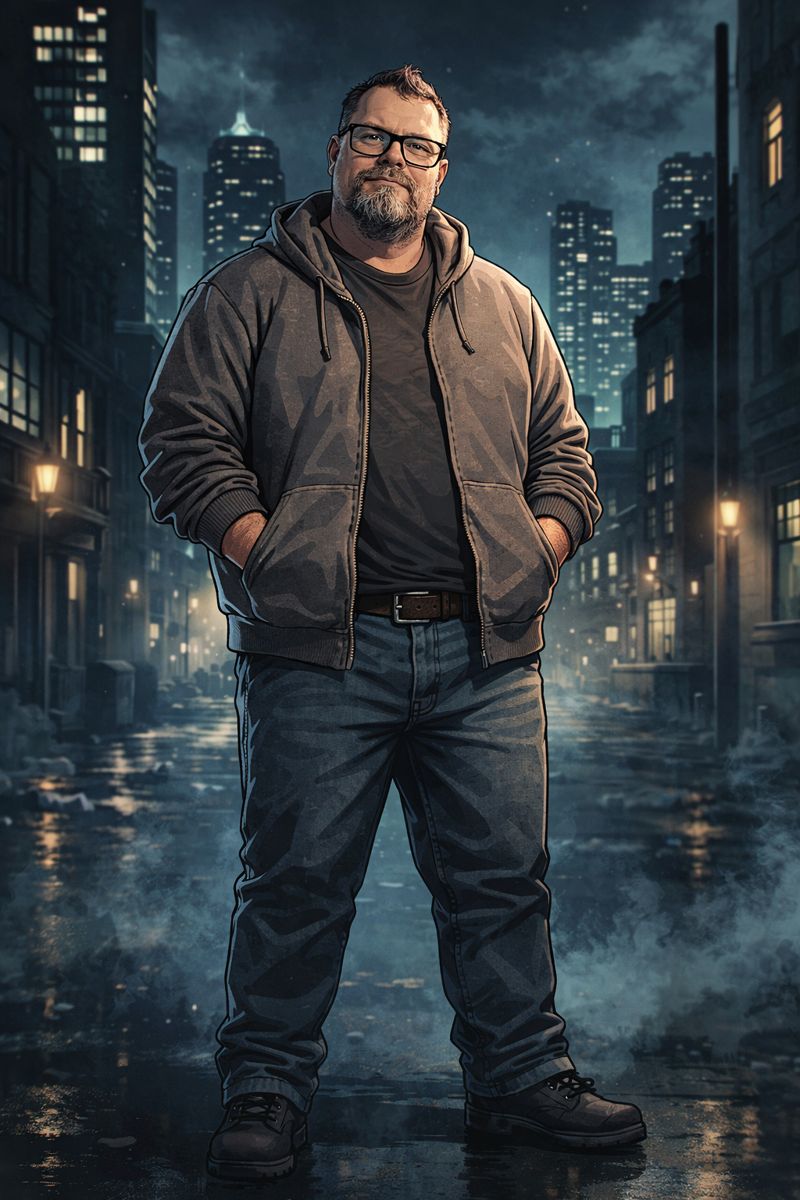
First, let me make this abundantly clear: there is no amount of magic in the world that can save you from gridlock in Toronto.
I was only catching the tail end of the rush home, and it still felt like I’d driven straight into some kind of liminal purgatory—one where vehicles lined up in endless, patient queues, inching forward toward driveways, parking lots, and garages where they would eventually curl up and sleep.
The Wizard-Mobile idled beneath me, engine grumbling in low protest. Brake lights stretched ahead in a red ribbon of shared resignation. Everyone here had somewhere to be. No one was getting there anytime soon.
I drummed my fingers on the steering wheel and sighed.
This was the great equalizer. Wizards, gods, demons, mundanes—everyone bowed eventually to the sacred tyranny of traffic. You could bend probability, tear holes in the veil, or wrestle with concepts older than language itself, but if the Gardiner Expressway said no, the answer was no.
The city loomed ahead in layers of concrete, glass, and accumulated impatience. Beneath the asphalt, the ley lines hummed—overworked, twisted, and knotted by generations of urban planning decisions that no divination had ever successfully predicted.
I checked the time. Late, but not catastrophic. Yet.
“Hang on, Bailey,” I muttered to the windshield. “I’m coming. Slowly. Painfully. At approximately three kilometers an hour.”
The Wizard of the 401, laid low by the very road that bore his name.
Somewhere ahead, something was wrong. Something was waiting.
And I was stuck behind a minivan with a Baby on Board sign and absolutely no sense of urgency.
It was at that point that I glanced down at the Gandalf bobblehead on my dashboard—grey hat, staff raised, eternally mid-pronouncement—and decided that while a wizard is never late, he should also occasionally acknowledge urgency.
Toronto traffic had made its ruling. Appealing the decision would take hours and several forms in triplicate.
So I did what anyone with a working understanding of this city’s glacial gridlock would do.
I pulled into the nearest parking lot, killed the engine, grabbed my coat and bag, and abandoned the Wizard-Mobile to its fate. On foot, I could cover the distance faster than the cars were advancing. That was less a tactical choice and more a damning indictment of urban planning.
I locked the van, muttered an apology to it—because it would take that personally—and set off at a brisk pace toward Bailey’s bakery.
Walking through the city always felt different than driving. You noticed things. The way the air changed block by block. The subtle pressure shifts where ley lines bent under concrete. The hum of too many people stacked too close together, their lives brushing past each other in near misses and unspoken collisions.
And, just faintly, I felt it.
A tug. Not strong. Not screaming.
But off.
That was never a good sign.
Bakeries had a particular kind of magic to them. Warmth. Comfort. Intentional nourishment. Kitchen witches like Bailey wove spells the way other people breathed—slow, steady, meant to sustain rather than impress. When something went wrong in a place like that, it usually meant something had gotten in that didn’t belong.
I lengthened my stride.
That’s when I spotted the patrol car.
City police—not RCMP, local jurisdiction—parked crooked near the shopfront, lights off but presence loud. One of the front windows of the bakery had been smashed in, glass swept aside into a glittering pile that caught the late afternoon light a little too well.
Bailey was outside, talking to an officer.
She was short, pleasantly rounded around all the edges, built like someone who knew the value of comfort and good meals. Soft brown hair framed her face, and there was, as always, a faint streak of flour somewhere she’d missed when cleaning her hands. Owlish glasses perched on a button nose, magnifying eyes that were usually warm and amused.
Right now, they were sharp. Focused.
My first thought was immediate and certain: she wouldn’t have called me if this were a normal robbery.
My second thought followed just as quickly: she also wouldn’t want the police deeply involved if it wasn’t.
Mundane authority and the magical community have never mixed well. There’s a long, ugly history there—accusations of consorting with devils, disbelief when help was actually needed, and an unfortunate habit of making witches the villains in just about every version of the story that survived into the mainstream.
That legacy lingers.
Most magical folk keep the mundanes at arm’s length. Not out of arrogance. Out of self-preservation.
I slowed as I approached, taking in the details. The break wasn’t sloppy. It wasn’t panicked. The glass had been shattered cleanly, deliberately. No signs of ransacking from where I stood. No flashing lights. No tape yet.
Bailey’s hands were folded tight around her apron.
She saw me then.
Relief flickered across her face—just for a second—but it was enough.
Yeah. This wasn’t a robbery.
I adjusted my coat, took a steady breath, and stepped closer.
Whatever had happened here, it had crossed the line where bread and coffee stopped being enough to fix it.
And that was my cue.
I gave Bailey a small nod, then one to the officer, letting her take the lead.
“This is the friend I was talking about, officer,” she said, voice steady in a way that told me it had taken effort to make it sound that way. “I called him to walk me home. I’m a bit rattled after being held up in my store.”
I caught the phrasing immediately. Held up. Robbery. Simple. Mundane. Nothing that would invite follow-up questions or extended curiosity.
Smart.
I nodded along, kept my mouth shut, and positioned myself just a little closer to Bailey—close enough to look natural, close enough that she could lean if she needed to. From the corner of my eye, I took in the broken window again. Late afternoon. Nearly broad daylight.
Bold.
Too bold.
But I said nothing.
“All right, ma’am,” the officer replied. He was young—fresh enough that the confidence in his voice felt rehearsed, carefully applied. He’d seen enough to know how this usually went. Smash-and-grab. No faces. No leads. Reports filed, hope offered, nothing recovered.
“We’ll do our best to find them. Stay safe.”
His eyes flicked between us, lingering just long enough to assess whether I looked like a problem. I gave him nothing. Just another concerned friend. Beard. Coat. Tired eyes. No reason to escalate.
He tipped his hat, turned back toward the patrol car, and climbed in.
The engine started. The car rolled away.
The moment it was out of sight, Bailey’s shoulders sagged just a fraction.
That was when I finally spoke.
“Okay,” I said quietly. “Now tell me what actually happened.”
She let out a long breath and fished a molasses cookie from the pocket of her apron, breaking it in half and taking a few quick bites like she was afraid it might disappear if she hesitated.
I clocked it immediately for what it was and said it quietly, gently. “You’re stress eating, Bailey. That usually means it’s bad.”
She paused mid-chew, glanced down at the cookie in her hand, then sighed again. “I’m always stress eating. It’s the trauma response my brain is conditioned toward.”
“Fair,” I said, nodding. No judgment. Just data.
I turned and started walking, angling us away from the storefront and toward where I’d ditched the van. She fell into step beside me without protest, still nibbling at the cookie like it was an anchor.
“Well,” I said, keeping my voice low and easy, “let me give you a ride home. We can talk in the van. The wards will keep the wrong ears from listening in.”
She glanced up at me, relief flickering across her face again—stronger this time.
“That sounds… really good,” she admitted.
“Good,” I said. “Because whatever actually happened back there didn’t feel like a simple hold-up.”
She didn’t argue.
That told me everything I needed to know.
The van was—thankfully—exactly where I’d left it.
I always worried that some carjacker with taste would see the mural and think, damn, that is a van worth stealing. It hadn’t happened yet, which I took as proof that criminals lacked imagination.
We got in. Doors shut. The wards slid into place with a familiar, comforting hum, the interior of the Wizard-Mobile folding into its quieter, safer self. Bailey finished the rest of her cookie in two decisive bites, brushed crumbs from her apron, and finally let herself talk.
“It was a slow late afternoon,” she said. “I was getting ready to close up a little early and make some savory sage muffins. You know—the kind that ward off evil spirits.”
“I do,” I said. “They’re excellent.”
She nodded, then continued. “Four guys came in. And I didn’t like the vibe they gave off. At all. Then I felt the wards snap. Not fade—snap. And something felt… wrong.”
I nodded slowly, mind already turning over possibilities.
It wouldn’t take much to break the wards on a public space like a storefront. Even good wards lose cohesion when the threshold is publicly permissive—open doors, constant foot traffic, a hundred unintentional invitations every day. Magic likes clear boundaries. Retail is chaos.
“Did they do anything?” I asked. “Say anything strange? Smell wrong? Feel cold?”
Bailey shook her head. “Not at first. That was the worst part. They were… normal. Too normal. Like they were wearing people the way someone wears a coat.”
I frowned.
And the reason I frowned was simple: most monsters that operated here—in cities, among people—were good at pretending to be human. If they weren’t, it usually meant one of three things. They were alien enough not to care. Uncanny enough to unsettle on purpose. Or old enough to believe mimicry was beneath them.
I wasn’t fond of any of those options.
Bailey swallowed, hands folded tight in her lap as she went on.
“Then one of them stepped up to the counter,” she said. “Dark suit. Hat. Sunglasses. Like he’d walked out of a casting call for Menacing Anonymous. And he leaned in and said—very calmly—give me the magic cookies or this gets ugly.”
I closed my eyes for half a second.
Magic cookies.
Not a metaphor. Not slang. Not code.
Kitchen witchcraft made tangible. Edible enchantments. The kind of thing you could smuggle past wards, past suspicion, past common sense. The kind of thing that didn’t look like magic until it was already working.
“That’s… specific,” I said carefully.
Bailey nodded. “Too specific. I don’t advertise what I bake. Not the real stuff. The labels are vague on purpose.”
“So they knew,” I murmured. “Not guessed. Knew.”
“And they weren’t scared,” she added. “Not of me. Not of the wards snapping. Not of being seen. It was like they expected everything to go their way.”
I drummed my fingers once on the steering wheel, feeling the van’s wards hum softly in response.
“Bailey,” I said, keeping my voice steady, “when you say gets ugly… what did that feel like?”
She hugged herself, shoulders drawing in. “Like pressure. Like the air got heavy. Like if I said no, something would crawl out of them instead of them pulling a gun.”
I opened my eyes.
Yeah.
That wasn’t a simple robbery.
“So they broke your front window on the way out?” I asked, mostly to confirm what I already suspected.
Bailey nodded, jaw tightening. “Yeah. I gave them everything—every enchanted baked good I had ready. And then, on the way out, the big guy in the brown suit just… punched the window. Shattered it. Like vandalism was the frosting on the being a jerk to me cupcake.”
I exhaled slowly through my nose.
“That tracks,” I said. “That wasn’t about intimidation or escape. That was punctuation.”
She looked at me. “Punctuation?”
“Yeah,” I said. “They already got what they came for. Breaking the window was them saying this didn’t cost us anything. No fear. No rush. No consequences.”
I didn’t like that at all.
Monsters who steal are bad enough. Monsters who steal and then break something for fun—those are usually sending a message. Either to the victim, to the neighborhood, or to someone they think is supposed to be paying attention.
Given that she’d called me?
Probably the last one.
I leaned back in the driver’s seat, staring out through the windshield as traffic crawled by, mundane and oblivious. “How many items did you give them?”
Bailey swallowed. “A lot. Warding bread. Sleep scones. Three dozen calming cookies. Two jars of focus biscotti. And…” she hesitated, then sighed, “…the rosemary-lavender honey rolls.”
I winced. “Those are good.”
“They help with magic resistance,” she said quietly.
That did it.
I nodded once, slow and deliberate. “Okay. So this wasn’t random, and it wasn’t small-time. It fels like someone’s building a stockpile.”
She rubbed her arms, like she couldn’t quite shake the feeling yet. “What kind of someone?”
“The kind who doesn’t want to risk casting magic themselves,” I said. “Or being seen doing it. The kind who wants effects without fingerprints.”
I started the engine, the Wizard-Mobile answering with a low, irritated rumble.
“Bailey,” I said gently, “I need you to do a few things when you get home. First: don’t bake anything enchanted to sell at the store for a while. Not even the mild stuff. Second: if anyone comes back—anyone at all—you call me before you say a word to them.”
She nodded immediately. “Okay.”
“And third,” I added “you’re not walking alone for a bit. I’ll make sure of that.”
She let out a shaky breath. “I’m really glad I texted you.”
“Me too,” I said.
Because whoever those four were, they’d just made a very specific mistake.
They’d stolen from my friend.
And they’d done it loudly enough to get noticed.
I drummed my fingers on the steering wheel as we sat in the Wizard-Mobile, still parked. I didn’t pull out into traffic yet—no sense going nowhere fast. Toronto had already made its position clear on that front. So I used the pause to lay everything out, piece by piece, the way you do when you’re trying to see the shape of something ugly hiding in the fog.
“Alright,” I said slowly. “Four guys in suits. They triggered—and outright broke—your wards against supernatural interference. Gave you strong uncanny valley vibes. Walked in like they owned the place. Demanded your enchanted stock. Took everything. Then smashed the window on the way out.”
I glanced sideways at her. “Anything else you can tell me, Bailey?”
She chewed on her lower lip, eyes unfocused as she replayed it in her head. The van hummed quietly around us, wards holding, the outside world muted.
“Sorry,” she said after a few seconds. “Not a lot, I’m afraid, Chance.”
“That’s okay,” I said, and meant it. “You did good. You stayed alive. That matters more than details.”
I leaned back and continued, thinking out loud now. “It’s not much, but it is a start. It tells me they’re either tied to the magical community or they can sense magic well enough to know what you are and what you sell. Mundane criminals don’t snap wards by accident.”
She nodded faintly.
“They also wanted everything,” I went on. “Not just one type of enchantment. No specifics. That tells me a few things. Either they don’t actually understand the finer points of applied magic—what does what, what stacks, what backfires…”
I tapped the wheel once.
“…or they’re greedy. Possibly both.”
Bailey gave a weak, humorless smile. “That’s… not reassuring.”
“No,” I agreed. “But it’s informative.”
I stared through the windshield at the slow crawl of cars, brake lights glowing like a ritual circle of shared misery. “Smart operators come in with a list. Dumb ones grab the whole shelf and hope something works. Dangerous ones don’t care what works, as long as something does.”
I looked back at her. “Did it feel organized, or did it feel sloppy?”
She didn’t answer right away. Then: “Calm. Like they weren’t in a hurry, but organized? Not sure.”
That settled heavy in my chest.
“Yeah,” I said quietly. “I was afraid you’d say something like that.”
I shifted gears—not the van, just my thinking. “Okay. First priority is keeping you safe. Second is figuring out who benefits from stealing low-profile, high-utility magic without drawing arcane attention.”
I cracked a small, reassuring smile for her. “Which, inconveniently for them, is kind of my specialty.”
Bailey blinked slowly “Both vague and specific at the same time, very on brand for you Chance”
I finally signaled and eased the van toward the exit of the parking lot.
“Let’s get you home,” I said. “Then I’m going to start asking some very pointed questions in places that don’t like answering them.”
Somewhere out there, four men in suits thought they’d gotten away clean.
They were wrong or so I'd hoped.
It didn’t take long to get to Bailey’s place—a nice enough apartment, one of dozens of cookie-cutter buildings that repeated across the city in slightly different permutations. Beige brick. Neutral siding. The kind of place that tried very hard not to stand out.
Sometimes that was a blessing.
I walked her from the van to the elevator, then down the short hall to her door. The building smelled faintly of cleaning solution and someone else’s dinner, grounding in the way mundane spaces often are.
“Is Spencer home,” I asked quietly as we stopped, “or still overseas?”
Spencer—her husband. Mundane, but adjacent enough to our world to know when not to ask questions. UN peacekeeper. Respectable moustache. Ten out of ten upkeep. The kind of man who could project calm even when everything else was on fire.
“Still away,” she said, unlocking the door. “Won’t be back for weeks.”
I didn’t love that, but I didn’t show it.
“Want me to reinforce the wards on your place?” I asked. No pressure. Just an offer.
She shook her head. “I’ll handle it. Salt line, sage, iron nails in the door and window frames. Simple. Familiar.”
I nodded. That was solid work. Old, reliable, hard to mess up when your hands were shaking.
“Okay,” I said. “But if anything goes bump in the night—anything at all—you call me. I don’t care what time it is.”
She met my eyes, really looked at me, then nodded. “I will. Thank you, Chance.”
“Anytime,” I said. And I meant that too.
She stepped inside. The door closed. I waited until I felt the wards settle—nothing dramatic, just the quiet sense of a space being claimed and defended—before turning back toward the elevator.
As I rode down alone, my reflection stared back at me from the polished metal doors. Tired. Focused. A little too alert.
Four things masquerading as thugs.
And what I hadn’t told Bailey—what I hadn’t wanted to say out loud—was the creeping worry that they wouldn’t stop with her shop. Independent magical operators were always at risk. That was the price of not paying for protection. Not buying into the old systems.
If you wanted to be safe, you paid for a stall at the Goblin Market.
Gold. Favors. Guilt. Names. Promises. Sometimes gods knew what else.
In return, the Market gave you space, recognition, and a much higher degree of safety from theft. Hurt a stallholder and the Market noticed. Hurt them badly enough and the Market responded. Quietly. Permanently.
Independent shops like Bailey’s didn’t get that luxury.
The thought followed me out of the elevator, fingers tapping against my thigh as I crossed the lobby. The pattern fit a little too well. Theft of magical goods. Intimidation. Vandalism. Men in suits who didn’t care about witnesses. Leaning on independents would drive business back toward centralized control.
And hiring supernatural muscle?
Easy enough, if you knew where to look.
The Market—or one of its keepers—would benefit from that kind of pressure. Even if they weren’t directly responsible, information had a way of pooling there. Secrets changed hands like currency.
I slid into the front seat of the Wizard-Mobile, shut the door, and started the engine. The mural wizard glared forward like he approved of this course of action.
“Alright,” I muttered, pulling out into traffic. “Let’s go ask some questions in a place that hates being questioned.”
My first stop was the Goblin Market.
Toronto is a big city, and our Goblin Market reflects that—solidly sized, busy, important. Not as big as New York, L.A., or London, though. London’s is something else entirely. I’d been there once. Wendy had taken me on a tour, grinning the whole time like she was showing off a beloved disaster, proudly declaring it the oldest Goblin Market in the world.
She wasn’t wrong.
London’s sprawls across a pocket dimension that eats several city blocks and still asks for seconds. It hums with age. Ours doesn’t have that weight—but it has momentum, and that counts for a lot.
Toronto’s Market squats in what most of the world believes is an old warehouse. Brick. Rusted signage. A place that hosts flea markets and swap meets on weekends if you squint at the paperwork just right. I pulled into the parking area and immediately noted the number of vehicles—too many for a normal weekday, too eclectic for anything mundane.
That was always the tell.
The Markets drew everyone. Actual practitioners with real talent. Supernaturals from both the Earth side and the Otherworld side of the veil. And, occasionally, mundanes—desperate, unlucky, or curious enough to stumble into something they really shouldn’t have.
Some left richer.
Some left wiser.
Some didn’t leave the same way they came in.
I cut the engine and sat there for a moment, watching people drift toward entrances that didn’t quite line up with the building’s geometry. The air felt… transactional. Heavy with intent. Every conversation around here came with invisible price tags dangling off the words.
The main reason people came was simple: the Goblin Markets didn’t care about morality or ethics.
They cared about exchange.
You want a cure? Pay.
You want a weapon? Pay.
You want information, silence, a miracle, or a second chance? Pay.
Buyer beware wasn’t a suggestion here—it was a survival rule.
I opened the door, stepped out, and adjusted my coat. Somewhere beyond that warehouse wall, Market Space was already shifting to accommodate tonight’s business.
If someone was leaning on independents like Bailey, this place would know why.
And whether they admitted it or not, I was about to find out what the price of that knowledge was going to be.




When you will upload the next part?
My uploads arent always consistant, real life and the full length novels I work on tend to take priority but I try to do a new chapter once a week when the stars all align but I can't promise thats always going to be the case.
Oops sorry this site can't notify me about your comment. Can we chat on any other platform? I'm not active on this site.